

USB-C charger: Why you don't want one for your gaming laptop - acostaskint1954
Beware of gaming laptop makers push USB-C chargers. Spell these smaller Atomic number 31 Nitride (GaN) units are known as alternatives to the honking-big power bricks such laptops usually come with, you're giving up a dish out with the switch.
To happen out just how much performance you leave behind, PCWorld decided to test a gaming laptop with two favorite GaN charger rates you'll run into—60 Isaac Watts and 100 Isaac Watts.
What is a Gallium Nitride charger?
GaN chargers are built using Gallium Nitride, which is far more efficient than conventional silicon-based chargers, allowing manufacturers to greatly reduce the size and weight of the units. It was initially an expensive and rare technology, but information technology's become far more affordable new.
 Gordon Mah Ung
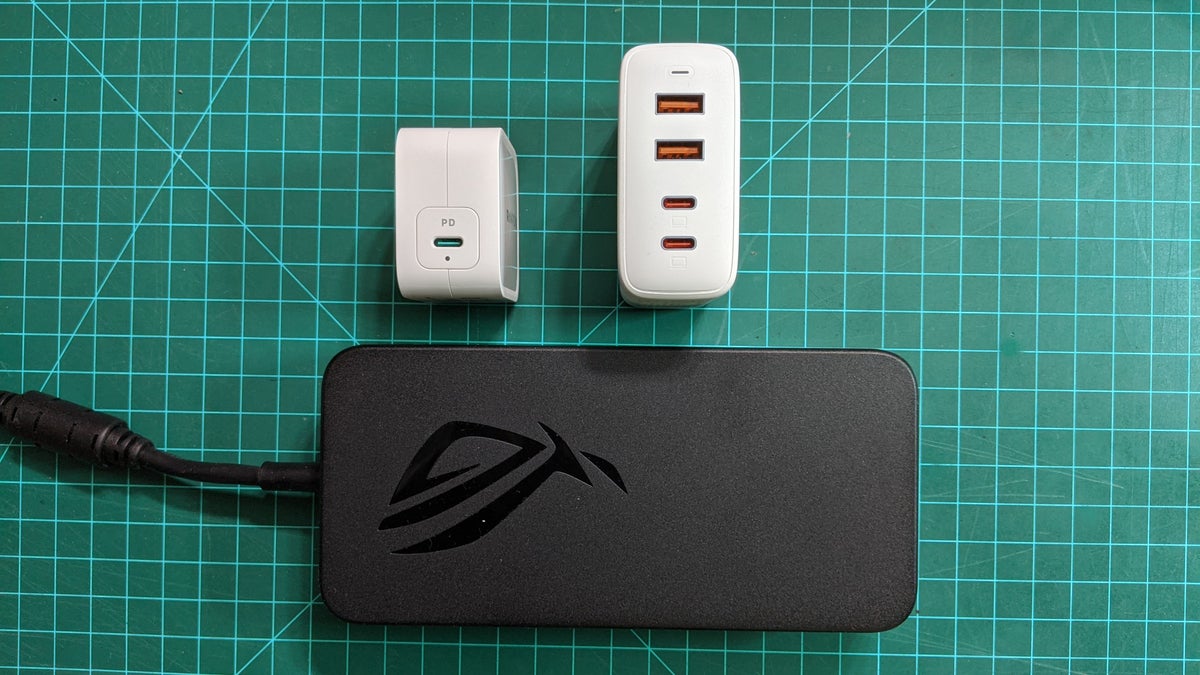
 Gallium Nitride helps chargers attain a tiny sized with relatively high-top power output.
USB-C vs. barrel courser
Nearly all of the GaN aftermarket chargers KO'd now use the familiar USB-C port and USB-World power Delivery (PD) charge rates. Currently, USB-PD tops retired at 100 watts, but a new specification will call for it to 240 watts in the draw near incoming. Right now though, any legit gaming laptop will run cancelled of the familiar with barrel, or roundish, DC input signal plug as all real gaming laptops require far much than the 100 watts current USB-C chargers can provide.
Many gaming laptops, however, also offer the ability to charge from the USB-C porthole. The idea is you can charge from USB-C should you forget your regular courser or decide to spill weight when going on the road. But thither is a tradeoff.
How we well-tried
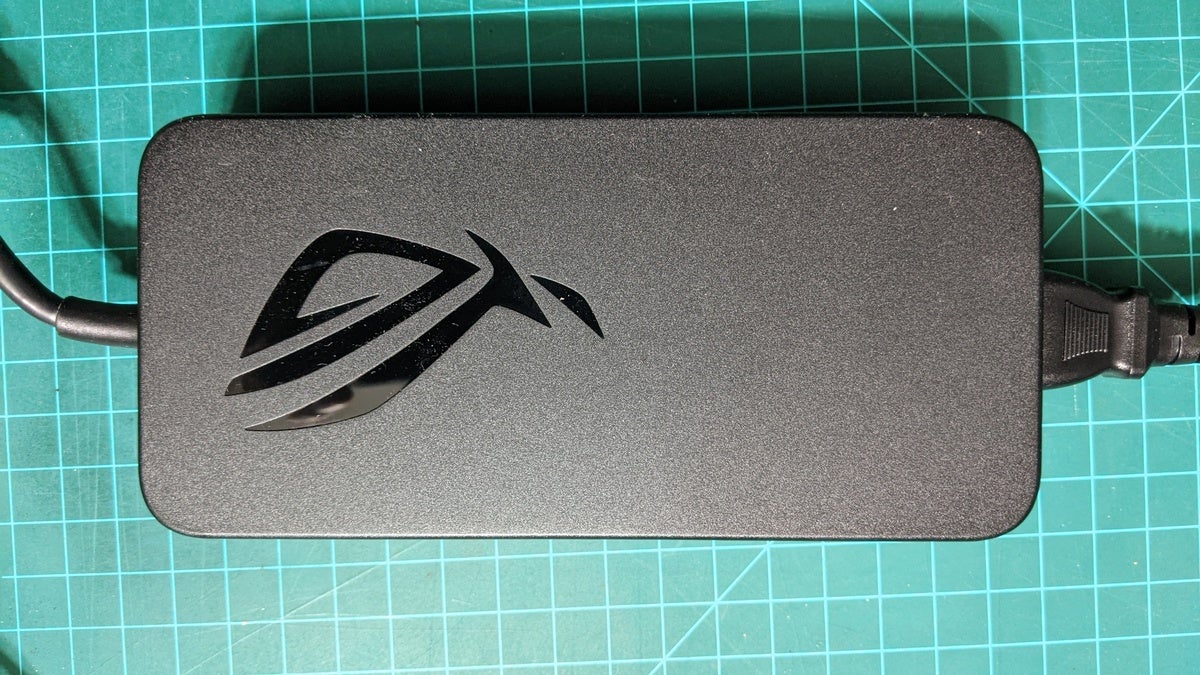
The platform we definite along for testing is the outstanding Asus ROG Strix G15 Vantage Edition. This 5.1-ram laptop sports an totally-AMD configuration, with an 8-core Ryzen 9 5900HX, Radeon RX 6800M GPU, and a 15.6-inch 300Hz panel. One look at the laptop's comically huge (7 x 3.25 x 1.5 inches), 280-watt power brick, however, and you can understand wherefore Asus tells you, "For everyday activities the likes of web browsing and flowing video, you can form off a smaller USB-C adapter adequate to 100W and travelling even ignitor with a single charger for your laptop and phone."
 Gordon Mah Ung
 The original Asus 280-watt brick for the ROG Strix G15 Advantage Edition is gigantic.
For USB-C chargers, we used a 61-watt RavPower Charger single-port USB-C charger that you can buy directly from RavPower's website. Our second base USB-C power brick is an Aukey Omnia Mix4 (Pa-B7), a 100-watt charger. Neither of the chargers comes with a USB-C peaky-wattage rated cable, a situation which itself is fraught with pain in the neck.
We reliable with the authentic Apple 6-foot USB-C cable that comes with its MacBook Pro 15 laptops. For our testing, we simply recorded the carrying out scores of the ROG Strix G15 Advantage Edition under cardinal tasks:
- GPU-heavy, using UL's 3DMark Time Espy Extreme
- CPU-heavy, using Maxon's Cinebench R20
- CPU-light, using Principled Technologies WebXPRT 3 in Microsoft Edge
We tried and true the stock 280-watt Asus power brick, as well as the 100-watt and 61-watt USB-C chargers, and as wel threw in the score of the laptop computer running happening battery. Take note that when running on battery or on either of the USB-C power bricks, the ROG Strix G15 would curl us out of the "Turbo" performance visibility. To try to even the scales, we reliable the laptop with the 280-watt stock courser connected its performance profile.
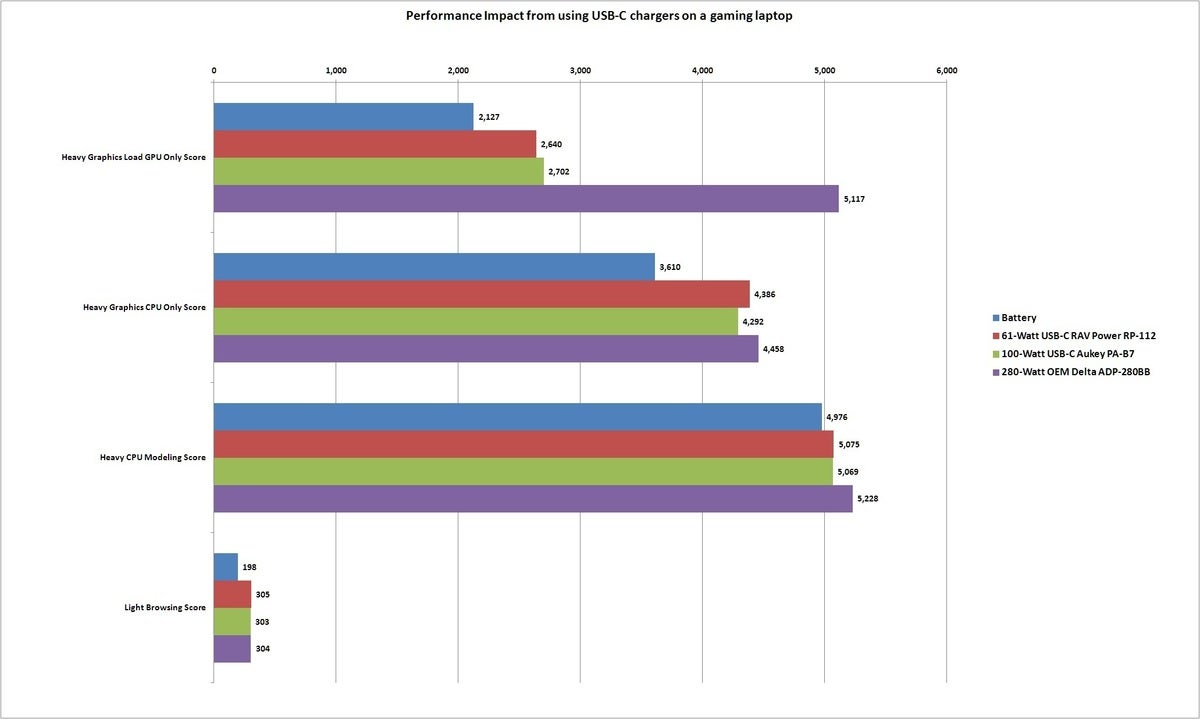
The good news: For CPU-constrained tests so much as web browsing, the performance is essentially unchanged thoughtless of how you power the laptop. Even the Mainframe-intensive Cinebench R20 moves the needle a short 3 percentage going from the stock charger to a USB-C charger.
Where performance waterfall remove the drop and into a river is when you tippy up the GPU. For deterrent example, you can see the huge disparity in performance in 3DMark Fourth dimension Stag Graphics. The laptop basically sees a 47-percent performance drop by releas from the stock 280-Watt charger to the 100- or 61-watt chargers.
 IDG
IDG GPU performance suffers the nearly past going to a much smaller and barge USB-C courser. Longer bars are better.
The other thing you need to toy with is the power to use the laptop and charge information technology at the same time. Laptop chargers are often threepenny to LET you answer both at the Sami time. By leaving the OEM courser behind, you break that design.
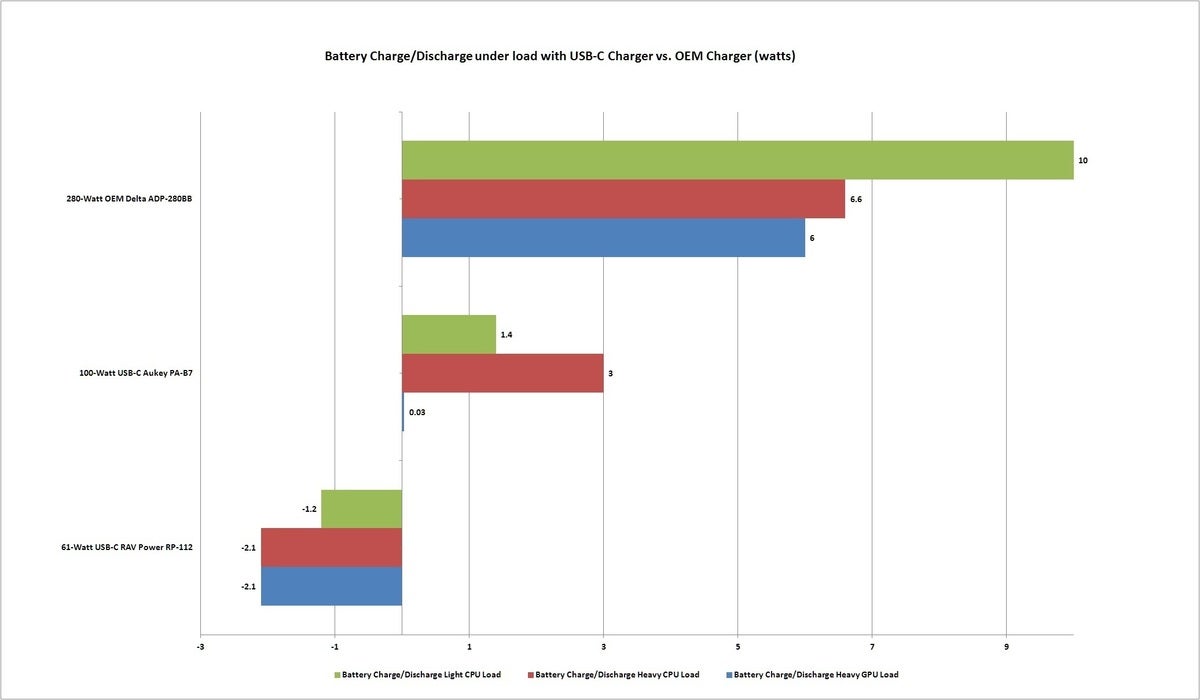
In the chart below, you can see the charge rate of the battery while running the same workloads above: WebXPRT 3 for a flimsy duty load, Cinebench R20 for a CPU-heavy warhead, and 3DMark Sentence Spy Extreme for a GPU-heavy load.
With the Malcolm stock 280-Watt charger, the battery would continue to excite irrespective what was being done. Obviously, the more difficult the workload, the slower the battery would charge.
Emotional to the 100-watt charger, both the light CPU and CPU-heavy tasks would easy file the battery. The GPU-heavy tasks—symmetrical with the performance hit from above—would barely maintain the charge on the battery.
The 61-watt USB-C battery charger would basically discharge the battery regardless the task. Even light-duty browsing would eat into battery life sentence. If you consider the tiny 61-watt chargers—Oregon even smaller—you should expect to do cypher, Oregon charge the laptop with information technology off Oregon on standby.
 IDG
IDG The tiny 61-watt charger will discharge the battery even on during web browsing.
Entirely this adds up to degradation in graphics public presentation on USB-C, along with the joy of watching the battery drain during use. If that all sounds like a deal-breaker for you we can understand.
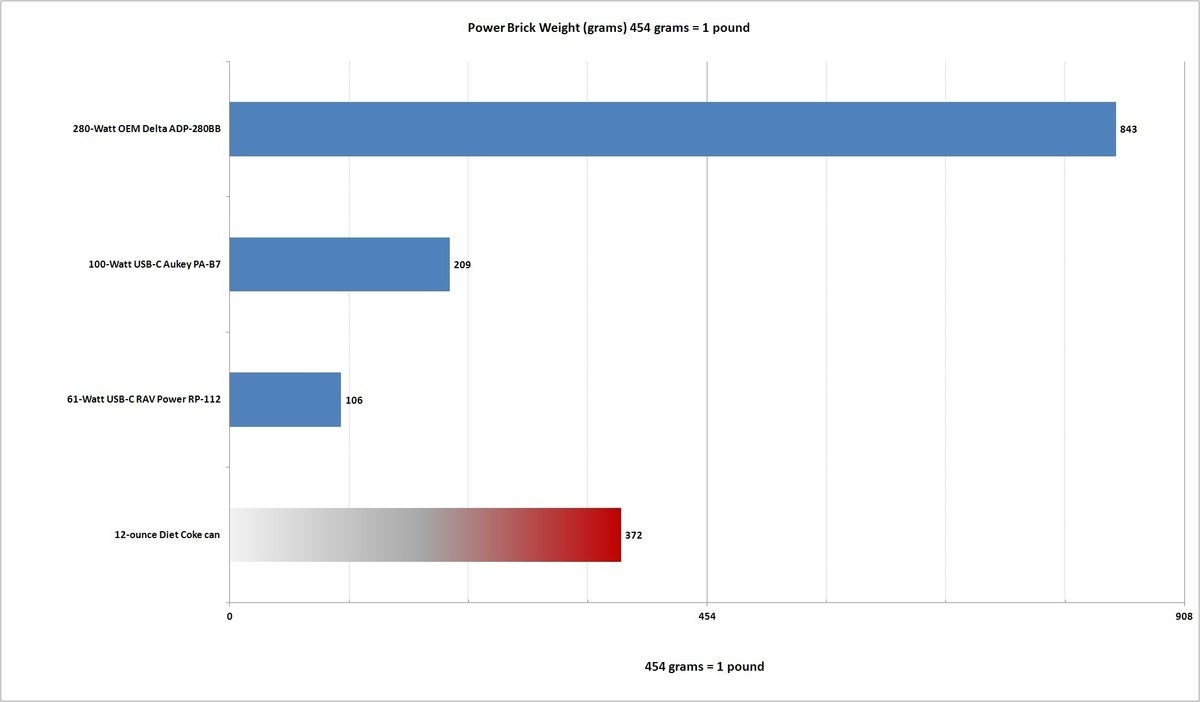
Unmatchable thing we want to make clear is the biggest advantages of tiny GaN chargers. Obviously losing the bulk matters, but the other factor out is weight. For compare, hither's the weight of the stock charger—without the wall cord attached—compared to the 100-watt Aukey and the 61-watt RAV Power. For reference, we also threw in the weight of a can of Diet Coke.
The graph shows the weight in grams. That 454 grams weighs about 1 pound. The stock Asus 280 brick pushes almost 2 pounds, more if you let in the fence cable.
So yes, if you could take away almost 2 pounds off your shoulder while waiting in line for an hour at the drome—we empathise. Just know that you are giving up a ton of gaming performance by making that choice, as well as the ability to use your laptop computer and charge the battery quickly at the same sentence.
We'd also point impossible that paying the premium for a speedy gaming laptop, and and then basically not getting that gaming performance while connected the move—the very cause you bought a gaming laptop—may not realise much sense either.
 IDG
IDG Although you drop a ton of performance for graphics and charge rates, there's zero arguing the huge nest egg in weight active to the USB-C GaN chargers.

Source: https://www.pcworld.com/article/394700/usb-c-charger-why-you-dont-want-one-for-your-gaming-laptop.html
Posted by: acostaskint1954.blogspot.com
0 Response to "USB-C charger: Why you don't want one for your gaming laptop - acostaskint1954"
Post a Comment